Yerba mate and matcha get compared constantly, and almost always by someone with a stake in the answer. Mate brands explain why mate wins. Matcha brands explain why matcha wins. The honest version is that they are two unrelated plants that happen to be green, caffeinated and marketed to the same person — and which one suits you depends on things no article can decide for you.
Here is what actually separates them.
They are not related plants
This is the part most comparisons skip, and it explains nearly every difference that follows.
- Matcha is Camellia sinensis — the same plant as green, black, white and oolong tea. What makes it matcha is the growing and the processing: the plants are shaded for several weeks before harvest, then the leaves are dried and stone-ground into powder. You drink the whole leaf rather than an infusion of it.
- Yerba mate is Ilex paraguariensis — a species of holly, native to South America. It is not tea in the botanical sense at all. The leaves are dried, sometimes smoke-cured, and steeped.
So one is a tea consumed as a suspension of powdered leaf, and the other is a holly infusion. “Both are green tea” is wrong twice over.
Side by side
| Yerba mate | Matcha | |
|---|---|---|
| Plant | Ilex paraguariensis (holly) | Camellia sinensis (tea) |
| Origin | Argentina, Paraguay, Brazil, Uruguay | Japan |
| Form | Dried cut leaf, steeped | Stone-ground powder, whisked |
| Stimulants | Caffeine + theobromine | Caffeine + L-theanine |
| Main taste | Earthy, grassy, often smoky, bitter edge | Umami, vegetal, creamy |
| Brew temp | About 70-80°C | About 75-80°C |
| Whole leaf consumed | No | Yes |
The caffeine question, and why every source disagrees
You will find confident numbers everywhere, and they contradict each other. That is not sloppiness — it is that the question is badly posed.
Matcha is comparatively predictable. You measure a fixed amount of powder, usually one to two grams, and consume all of it. Two grams lands most servings somewhere in the range of a weak-to-moderate cup of coffee.
Yerba mate is not predictable at all, because the traditional preparation refills the same leaf many times across a session. A single gourd might be topped up a dozen times. Comparing “a cup of mate” to “a cup of matcha” compares a fixed dose to an open-ended one.
The practical takeaway: if you want to know your caffeine intake, matcha is the easier one to control. Mate brewed as a single teabag is also controlled. Mate brewed traditionally in a gourd is a session, not a serving.
Why the energy feels different
Both contain caffeine, but each carries a second compound that shapes the experience.
Matcha and L-theanine
Shade-growing raises the leaf’s L-theanine content, an amino acid found in tea. L-theanine is the basis of the “calm alertness” matcha is known for — drinkers frequently describe the lift as smoother and less sharp than coffee, without the same edge.
Yerba mate and theobromine
Mate contains theobromine, the same mild stimulant that gives chocolate its lift. Theobromine acts more gently and lasts longer than caffeine. Mate drinkers tend to describe the effect as steady and physical rather than mentally narrow.
Worth being honest here: these are commonly reported subjective differences, and individual response to caffeine varies enormously. Anyone telling you exactly how a drink will make you feel is guessing.
Taste, plainly
Matcha is savoury before it is anything else. Good matcha is umami-rich, vegetal and slightly sweet with a creamy texture from the suspended powder. Poor matcha, or matcha made with water that is too hot, turns harshly bitter — most people who say they dislike matcha have had it made badly.
Yerba mate is earthy and grassy with a genuinely bitter backbone, and often a smoky note from traditional curing. It is more polarising on first taste than matcha and tends to grow on people. Unsmoked and air-dried mates are considerably gentler if the smokiness is the sticking point.
Preparation is the real lifestyle difference
This is the factor people underweight and then abandon a purchase over.
- Matcha needs a whisk, a bowl and about two minutes. Sifting the powder first prevents clumping. Water should be hot but not boiling. It is a small ritual, and it does not travel well.
- Traditional mate needs a gourd and a bombilla, and is built around refilling and sharing over an extended sitting. It is deeply social by design.
- Mate in a teabag skips all of that. You lose the ritual and the session, and you gain the ability to drink it on a Tuesday morning without equipment.
Antioxidants: the wrong question
“Which has more antioxidants” gets asked constantly and cannot be answered cleanly, because the two contain different compound classes.
Matcha is rich in catechins, particularly EGCG. Yerba mate is rich in chlorogenic acids and saponins. These are not interchangeable units on a shared scale, and the totals reported depend heavily on which assay a study used. Any article ranking them with a single number has flattened something that does not flatten.
Which one should you actually pick
The useful version of this question is not which is better, but which fits.
- Pick matcha if you want a controlled, repeatable caffeine dose, prefer savoury and creamy flavours, and enjoy a short daily ritual with equipment.
- Pick yerba mate if you want something that carries through a long morning, like earthy and bitter flavours, or want a drink built for sharing.
- Pick neither exclusively. They are not competitors. Plenty of people drink matcha in the morning and mate in the afternoon, and the only rule worth observing is watching total caffeine across the day.
One note on temperature
Whatever you choose, do not brew either with boiling water, and do not drink any beverage scalding hot. With matcha, water straight off the boil scorches the powder and makes it bitter. With mate, traditional practice has always used hot-but-not-boiling water for the same reason. Letting a kettle stand for two or three minutes off the boil solves it for both.
Where yerba mate fits in a blend
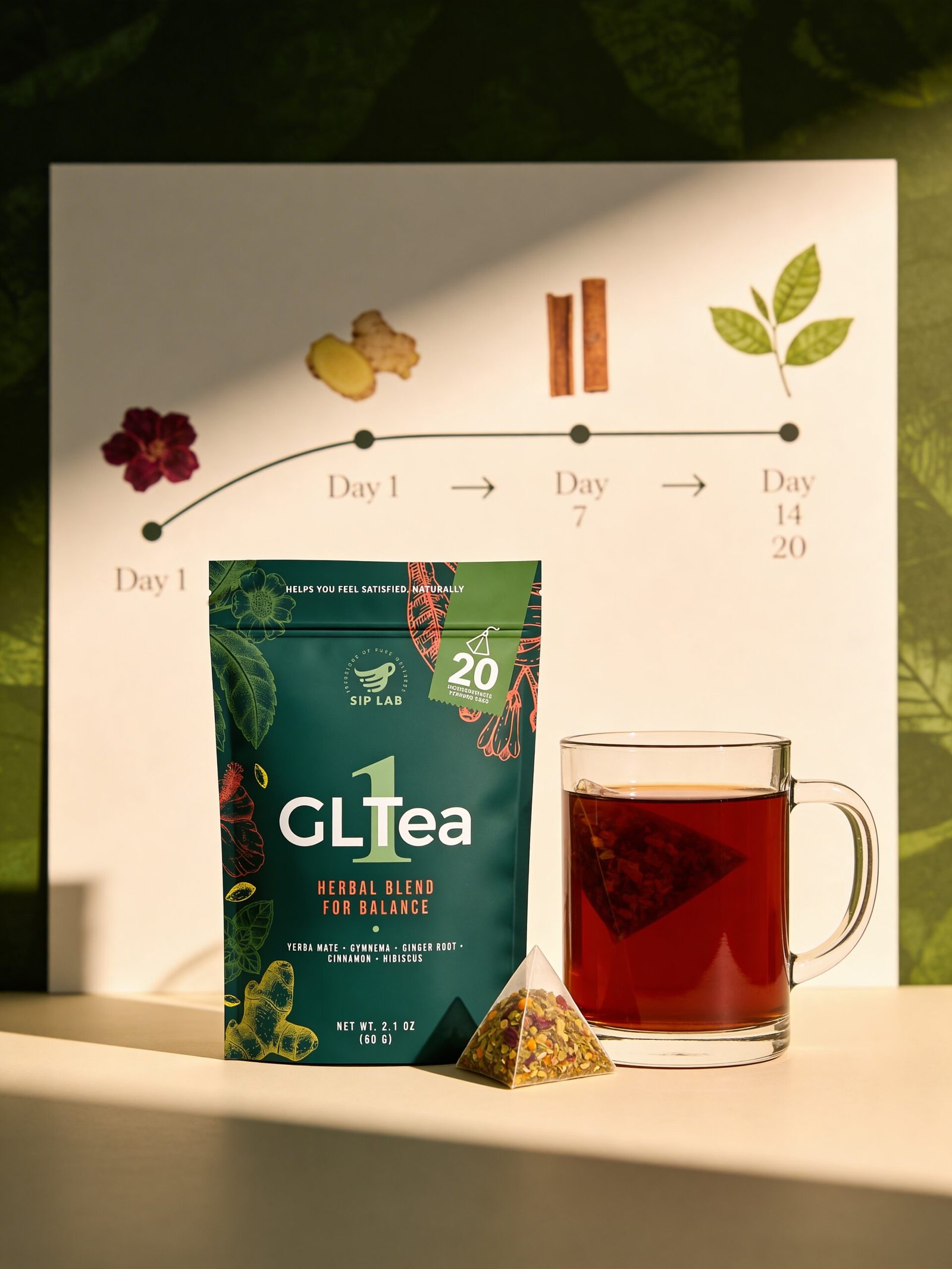
Mate does not have to be drunk alone. Its earthy, grounding character sits well underneath brighter botanicals, which is why it anchors GLTea-1 rather than leading it — whole-leaf mate in a pyramid sachet, with hibiscus and ginger over the top and no gourd required. If the flavour appeals but the ritual does not, a blend is the low-friction way in.
Evidence snapshot
- Botanical identity: yerba mate is Ilex paraguariensis, a holly; matcha is Camellia sinensis, the tea plant. They are unrelated species.
- Shade-growing and L-theanine: reducing light before harvest is well established as raising L-theanine and chlorophyll in tea leaf, which is why matcha is both greener and higher in theanine than standard green tea.
- Theobromine in mate: yerba mate contains theobromine alongside caffeine, a combination not present in meaningful amounts in Camellia sinensis.
- Distinct polyphenol classes: mate’s profile is dominated by chlorogenic acids, matcha’s by catechins including EGCG — different compounds, not different amounts of the same one.
- Caffeine figures vary widely across published sources for both, driven by serving size, leaf quantity, water temperature and, for mate, the number of refills.
Frequently asked questions
Is yerba mate stronger than matcha?
Per fixed serving they are broadly comparable, but mate brewed traditionally is refilled repeatedly, so a full session delivers considerably more caffeine than a single bowl of matcha. Prepared as one teabag, the two are closer than most comparisons suggest.
Does yerba mate taste like green tea?
Not really. Both are grassy, but mate is earthier, more bitter and often smoky, and it is not made from the tea plant at all.
Can I drink both in the same day?
Yes. The only thing worth tracking is total caffeine, which for most adults is usually discussed in the region of 400 mg a day — though sensitivity varies and that figure is a general guide, not a personal one.
Which is better for a coffee replacement?
Mate is the closer substitute for people who want volume and a long, steady morning. Matcha suits people who want a smaller, more controlled dose with a calmer character.
Why does my matcha taste bitter?
Almost always water that is too hot, too much powder, or culinary-grade matcha used for drinking. Cooler water and less powder fix most of it.
Do I need a gourd to drink yerba mate?
No. The gourd and bombilla are traditional and worth trying, but mate works perfectly well loose in an infuser or in a teabag.
Bottom line
Matcha is powdered tea leaf you consume whole, built around a short precise ritual. Yerba mate is a holly infusion built around a long shared one. The caffeine content is closer than the marketing on either side implies, the antioxidant comparison is not a real contest, and the deciding factor for most people turns out to be taste and preparation rather than anything nutritional.
These statements have not been evaluated by the Food and Drug Administration. This product is not intended to diagnose, treat, cure, or prevent any disease.